Thursday, October 6, 2011

When a person dies, what becomes of their digital self?

I logged into my Facebook yesterday, and was surprised.  Beyond the huge news that Steve Jobs, founder of Apple and leader in the modern tech revolution, had died at the age of 56, I also found news that a Facebook friend, who went by the digital name Ginger Snaps (real-world name: Melissa Hayes), had also died (the SUV she was driving crashed into an abandoned home, killing her and her cousin in the passenger seat).

Ginger Snaps' death surprised me in a weird way.  I am quite comfortable with death and loss (living without religion makes death far easier to deal with).  The reason I was surprised was because I felt myself unsure of whether or not the person I knew was really gone yet.  Let me explain:

In our modern world, with our social networking accounts and projections of ourdigitalselves through the internet, the person we project is not necessarily the same person we are in our real lives.  Melissa dies yesterday.  Her physical self is no longer extant.  But, much as we are preserved after our deaths through the memories of others and the impacts we've made in the world, her Facebook account still exists and her digital self is still there; silent, but there.  There are now many people posting their condolences and such on her FB wall.  It makes it seem like her account is still somewhat active.  I'm sure over the next few days and beyond, that traffic to her account will slow down to a trickle and then stop.  And her digital self will slowly fade as well.  But the account will remain active unless someone comes along and deactivates it.  Without someone to put an end to our digital selves after our physical deaths, then I suppose that digital self will remain, like a shadow.

Makes me wonder about where we're going.  The future is always far more exciting and surprising than what we ever thought possible.  Most people who lived in America in the early 1900's C.E. could never have guessed that we would have digital computers and internet with social groups which would allow for us to create digital selves.  There are always dreamers.  The sci-fi writers, the speculators, the scientists...  But our thoughts about what will come are usually only small tips of the icebergs that wait in the distance.

Tuesday, October 4, 2011

Listening to the soundtrack for the film "The Fountain".  Moving music.  Clint Mansell did the entire soundtrack.  His compositions are full of emotion.  They are cerebral and smooth, yet every now and then the songs get powerful enough to make me feel energized and alive.


Monday, September 26, 2011


"Happiness is the absence of the striving for happiness."
-Zhuangzi


Thursday, September 22, 2011


The Earth is the cradle of humanity, but mankind cannot stay in the cradle forever.
-Konstantin Tsiolkovsky


It definitely seems like there are some of us on this planet who look to the stars and dream about what lies ahead (for us on this planet and for our lives beyond) and then there are many who look no where but to the present.  I truly have been wondering more and more lately about the nature of humanity.  Are we bound to diverge so much that we become new, distinct species?  We already have groups of people who will not breed with other groups.  The far-right, conservative christians have entrenched themselves pretty deeply in some areas and seem to indoctrinate their children so heavily that those children don't fit in with modern day thinking.  How will our society continue to evolve when groups within cannot work together?  If Earth is our cradle, perhaps it is nurturing and raising us to be very different.  Perhaps part of biological evolution for conscious species is to diverge into new varieties.  I wonder if, when we do come to leave the cradle and "grow up", if a good proportion of what was humanity will remain behind, stuck in their ways and unwilling to change.

Wednesday, September 21, 2011

Gearing up to move forward with building a sulfur spring analog in the lab.  I realized I have forgotten a lot of what we covered in geochemistry for equilibrium constants, dissolution in solutions, solubility, and the like.  Going back and reading "Thermodynamics of Natural Systems" to try to build up a sound idea of the theory once again.  I hope I can get this thing moving forward before too long.

Here's a fun link.  Syd Mead is the guy who developed the futuristic scenery for films such as Blade Runner, Tron, Alien, and Minority Report.  His art is fantastic!  Check his site out:
http://sydmead.com/v/11/

Friday, September 16, 2011

Mmmmmm.  Big ol' cup of coffee and a relaxed morning.  Just what I needed.

Was just reading about yet another awesome discovery made using the Kepler space telescope.  Astronomers have discovered a saturn-size planet which orbits in a binary star system.  Much like the fictional Tatooine from "Star Wars", this planet experiences double-sunsets from its surface (and other cool variations of the two stars rising and setting at different distances from each other relative to the planet).  Too cool!    

Here's an image (artist rendering of course) from the NASA press release:


Wednesday, July 20, 2011

A Decade Past

Have been thinking a lot lately about this past decade, from where I've come to where I am going.  Ten years ago, when I was 17, I was still using a lot of drugs, still expelled from high school, still doing a lot of self-discovery, and I had just given my son for adoption.  I think my son's birth, the three days we had with him, and his adoption were moments that strengthened me.  They made consider my own mortality and my own ambitions. When I was a kid I had such great dreams of becoming a scientist and sharing my knowledge with the world.  I wanted to go to space, I wanted to learn about life and the cosmos, and I wanted to be a great person.  My adolescence was a change from that ambition.  my adolescence really taught me humility; taught me about who I really was and what it would take for me to excel.  Ten years ago I realized, to quote from Star Trek: First Contact, that I should not "try to be a great man" but rather "just be a man, and let history decide the rest".  I intend to be the best human being I can be, knowing that I will make mistakes and sometimes fall to my own wants, needs, and simple pleasures along my journeys, and accepting that.  These past ten years have taught me so much about what it means to be human, to have to work for something you want, and to feel unsure about the future.  I wonder where these next ten years will take me.  What will I be doing when I'm 37?  I hope, whatever it is that I am doing in ten years from now, that I will be doing something far different than what I'm doing now and exploring and discovering new things about myself and others.

Monday, July 18, 2011

The Island of Dr. Moreau

I had never before read The Island of Dr. Moreau (H.G. Wells, 1896), but I had seen two film versions.  I was very curious to see how it was the Moreau had turned the animals on his island into humanesque creations.  I was a little surprised to learn of the method.  Moreau created the Beast Men by tinkering with adding and removing body parts through vivisection (live surgery).  Wells speculated that in his near future that the process of tissue graphing and tissue manipulations that a simple surgeon could be capable of making animals walk as bipeds and think and speak like humans.  Of course, this idea is very fallacious, but then you have to consider the time in which Wells wrote his story.  The novel was first published in 1896, though Wells' end-note to the book claims that the story stemmed from a short essay he had written for The Saturday Review in Januray of 1895.  At that time, vivisection was becoming hotly debated as a current issue of scientific morality in England.  It seems that Wells was triggered by the topic and inspired to dream what could happen if tissue graphing through vivisection allowed for the creation of new organisms, such that were alike to humans.  In the modern time, our knowledge of physiology and biology make it apparent that such manipulation is just not possible, but it is still a fun flight of fantasy to read the story.  I feel now that I must watch the films again.  If I recall correctly, the 1996 version (with Marlon Brando and Val Kilmer) changed the basic premise such that Moreau uses modern genetic engineering to create his beasts, which is far easier to 'swallow' for the modern science-savvy person.

Saturday, July 16, 2011

The Time Machine

Just finished H.G. Wells' "The Time Machine" for the third time in my life.  I love this story.  Such a provocative consideration of how social distinctions may drive the future differentiation of our species from the view of an educated man living in the late 1800's C.E.  I think a reading of "The Time Machine" is probably obligatory for anyone interested in ideas of time travel.  Though very dated, and lacking in scientific explanation for the underpinnings of the actual machine itself, "The Time Machine" shows how a rational thinker could view time before the beginnings of modern physics and without all of the inundation of temporal travel we see in modern sci-fi media.  I won't take up too much space here appraising the value of this fantastic read, but I will quote one line from the story that I found very interesting:

"There is no difference between Time and any of the three dimensions of Space except that our consciousness moves along it."

I thought this line was interesting for two reasons.  1) Wells' wrote this story in 1895, yet he is thinking fully in the realm of space-time, with time only serving as another dimension of space as we perceive it and possibly just as physically tangible of a dimension as the others, and 2) Wells wrote that our consciousness moves along in time, but implies that our consciousness does not necessarily move along in space.  I found this second bit to be really intriguing.  Was Wells implying that our consciousness is just that part of us that moves in time (the way our body moves in three-dimensional space), or was Wells stating something deeper about his take on what consciousness is?  I'm not sure what Wells meant to say with this, but I do have to wonder.  Any thoughts?

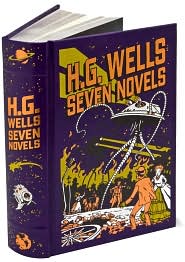
H.G. Wells: Seven Novels

Amanda and I recently went on another book-buying binge.  Wanted to get some more sci-fi for the shelves (well, more for the brain, but then for the shelves).  I came upon an H.G. Wells collection book at Barnes & Noble which contains seven of this famous authors most fantastical works.  Included are The Time Machine, The Island of Dr. Moreau, The Invisible Man, The War of the Worlds, The First Men in the Moon, The Food of the Gods, and In the Days of the Comet.  The book is bound in a beautiful purple cover with exceptional, classic sci-fi graphics.  Totally stoked to read all of Wells' classic writings.  Expect reports on this in the coming days/weeks.