Wednesday, January 14, 2015

Hunting for Food - My Entry Into the World of Hunting


Image from: http://www.artistridewi.com/data/photos/163_1r473_4649s.JPG

I love eating meat.  I always have.  I enjoy the taste of a juicy steak and the salivation-driving smells and flavors of beef brisket and pulled pork covered in BBQ sauce. I've enjoyed the American food staples of burgers and hotdogs when grilling with friends, and I've sought out uncommon meats like ground ostrich and kangaroo, meal worms and fried grasshoppers, and even horse stroganoff (which I had in the small town of Villigen in Switzerland). The few times in my life that I've had meat from animals that were taken from the wild by hunters, I've loved the taste and the aroma from that meat. Also, somewhere deep inside, it felt good to know I was eating meat that was taken from the wilderness.

We are an omnivorous species and that omnivory is part of what allowed us to develop civilization as we know it and to conquer the globe. However, our omnivore lifestyles (especially amongst Americans) have also become something of a danger to our civilization and to our planet. Over the past couple of years I've been leaning more and more toward getting into hunting for the meat that I eat. Hunting runs rich in my family's history and, although I have never hunted before, I feel a certain call from the wilderness - a beckoning to get out into the wild and hunt for my food from a wild source.  My girlfriend and I are planning on moving toward as much of a locavore lifestyle as possible; we want to grow our own vegetables, hunt our own meat, and buy locally as much as possible (of course, there are some things that we just can't get from close to home - like coffee). Can we change our diets to become more sustainable and healthier through growing our own vegetables and hunting our own meat? I truly hope so.


There are a lot of people in my country who subsist on diets of meat with sprinklings of other bits like cheeses and breads with maybe a stray slice of tomato or onion every now and then (don't forget to wash it down with a load of sugar and artificial colorings and flavorings in some water).  Such diets might not be so bad (still not great, but not so bad) if the foods came from sources where the producers had an investment in human health and global sustainability as opposed to maximizing profit, but that's just not the case.  I don't want to sound like some ranting lunatic ("them there big bad corporations") so here's a little history of food followed by my beginner's take on hunting and what I intend to gain for myself, my community, and our world by hunting.


The Beauties and Terrors
of Food Preparation

The Last Supper by Leonardo DiVinci
Image from: http://upload.wikimedia.org/wikipedia/commons/4/4b/%C3%9Altima_Cena_-_Da_Vinci_5.jpg

Just as with any other large heterotrophic organisms on our planet, our biology requires taking in organic compounds, vitamins, and other nutrients by ingesting other organisms, live or dead.  We've come to the point now where we add in lots of synthetic organic compounds that we create in labs, but most of what we eat requires that other organisms have done the hard work of taking inorganic and organic molecules from the environment and have then produced within themselves the nutrients that we we take once we ingest those organisms or parts of them (don't lie to yourselves, vegetarians, you also have to kill organisms to eat, but your killing is only slightly more removed from our genetic lineage; see below for more on vegetarianism).  As many of us were taught in school, amongst animal forms of eating there are carnivores (which eat other animals), herbivores (which eat plants), and omnivores (which can eat animals and plants).  However, there are more forms of eating in the animal world than that, including detritivores (which eat decomposing material from plants and animals), scavengers (which must search to find recently dead bodies of plants and animals to eat), and fungivores (organisms which eat only fungi).  Our species are omnivores (and we have been for a very long time), which means that we can eat meat and vegetables and fungi and even microbes (with the help of other microbes, of course!).

No one knows for sure when we started preparing our meals to improve the flavor and presentation of our food, but the act of spending time to prepare a meal (as opposed to just eating raw whatever bits we had at hand) is probably just about as old as hunting itself.  For hundreds of thousands to over a million years, we and our ancestors have taken extra time to ensure that our food was nourishing as well as tasty.  There are even some people out there who argue that preparing our meals, especially through the use of fire, might have given early humans a benefit over other primates.  Cooking gave us a great way to mix together our various food sources to ensure that we were getting all of the nutrients we needed, but also ensured that we spent more time working together (improving our socialization and probably helping to ensure the development of civilization).  One of the most enjoyable ways to socialize with other people is over a well-prepared meal.


A long history of cooking and food preparation led to the development of various ethnic cuisines and special types of meal preparation for various events of celebration in our lives.  Many religions have developed special meals for celebration over time, and various people across the planet have sorted out their favorite types of food and food preparation to form the national cuisines that many of us know of now.  Many of us love trying ethnic meals.  French, Italian, Indian, Mongolian, Latin American, Ethiopian, German, American, Japanese...  all of these words in the context of food signify a certain range of meals that I love to eat, and each of those types of food preparation have unique ingredients, cooking methods, and presentation styles that make each of them special in their own right.  Interestingly, the preparation of animal meat is included in nearly all of those forms of cuisine.

There are lots of reasons for eating meat.  Meat tastes great, it contains lots of the protein and nutrients that we need to survive, and the various studies that lots of vegetarians like to point to suggesting that eating meat is unhealthy are usually, when read closer, only concluding that eating too much meat or meat prepared in the wrong way is unhealthy.  That's where we get to the crux of the problem for meat eaters.  Meat tastes great and feels rewarding to eat, but there are way too many of us who cook their meat to well-done (which usually implies an increase in the number of carcinogens in the meat) and who eat meat for every meal, sometimes only meat for a meal.  As omnivores we owe it to ourselves to balance our diets, but many of us, especially in America, have a hard time with that notion.  

The over-consumption of meat in America has led to a scary reality: our demand for meat paired with corporate demands for profit have led to factory farming methods where the animals are treated inhumanely and the food itself has become jeopardized because of it.  I won't go on about the dangers of factory farming (though here is an article from the ASPCA on the issue and here is one from Sustainable Table), but I think any of us who've ever driven past a factory farm or have seen how these animals are treated have to feel, at least a little bit, like something is very wrong in how we are treating those animals.  There's a pretty large industrial cattle lot in northeastern Colorado, on the way up to Nebraska, that makes me cringe whenever I see it.  The cows, thousands of them, are stuck standing shoulder-to-shoulder in mud mixed with their own excrement, while they wait for the slaughterhouse.  The condition is the same in many industrial farm settings for chickens and pigs as well.  If you find the nature of factory farms as unsettling as I do, here is a website that offers a Factory Farm Map to show you how many there are and how well-distributed they are across the United States (the site is produced by Food and Water Watch).

Confinement of Pigs

I don't mean to blast livestock farming. I'm sure there are lots of farmers out there who are doing their best to ensure that their animals are treated well as they make their journey from birth to death; the locavore movement and conscious consumers are driving the demand for more meats produced in more ethical manners. Even though I personally want to be as sustainable as possible, I'll still have a cheeseburger every once in a long while from a fast food joint, enjoy the meat extravaganza at a Brazilian steakhouse, or put down a hearty breakfast of eggs and bacon. I don't see the need to fully separate myself from what I've enjoyed for much of my life, but I do know I can find more enjoyment by ensuring that my food mostly comes from sustainable sources and that I am doing my best to eat a balanced and healthy diet. It's hard sometimes to think about the American obesity epidemic when I live in a town like Boulder, Colorado (one of the healthiest and fittest towns in the nation), but it doesn't seem unfair to associate a large part of that problem with the over-consumption of meat as well as the abundance of highly-processed foods in the American diet (I haven't really talked about that side of the problem, but I think we all know by now that the ridiculous amount of sugars and synthetic substances in our food can't be good for us, even if they make us feel good for a moment in time).

Image from: http://www.slate.com/articles/health_and_science/
medical_examiner/2010/03/end_the_war_on_fat.html


"Why not just go vegetarian?"


I suppose a lot of my friends and family who are vegetarian or vegan would wonder why I don't just go fully vegetarian if I'm so worried about eating sustainably. There are definitely great arguments to be made for eating meatless diets. For instance, the three micro-populations on the planet that have the greatest number of centenarians (people who live to be over 100) all eat diets that are either vegetarian or that contain very little meat (here's another article that mentions the top 5 places with the longest living people).  Eating vegetarian diets has been shown in a plethora of studies to appear very healthy, but (as Authority Nutrition mentioned in a post I linked above) very few studies have actually considered that most vegetarians are already health-conscious people and are likely doing other things to keep themselves healthy as well. I would throw down real money on a bet that vegetarians who eat boatloads of candy and highly-processed breads, drink soda, and live mostly sedentary lifestyles would start skewing such studies to show that although vegetarian diets can be good, they are by no means the sole solution.  Where vegetarian and vegan diets really kick-ass compared to mostly meat-based diets is in the realm of sustainability.  As this article from the American Journal of Clinical Nutrition shows, the common meat-based diets (I would argue they are "meat-overconsumption diets") require far greater land, water, and energy resources than do typical plant-based diets of the same calorie-load.  Without a doubt, eating a plant-based diet is far more sustainable than the typical meat-overconsumption diet.  But that doesn't mean that we can't make conscious and sustainable decisions while choosing to eat meat.  I think that being smart about choosing how much meat and which meats to eat is one huge step we can all take toward making better sustainable and health-conscious decisions with our meat eating.  This post is really just the "tip of the iceberg" for me on this issue, but when it comes down to it, I think the decision to hunt for the meat I will eat will make me far more conscious of where my food comes from, it will ensure that I eat locally-produced meat from healthy sources, and it will let me experience the entire process of preparing the meat for consumption.  That final bit is something that bothers me greatly: too many Americans who eat meat think of their meat as something prepared for them or something that comes wrapped in plastic at the grocery store and seem to have forgotten that an animal has to be killed and then butchered before that meat can be so nicely wrapped and prepared.  I know that I'll get more out of hunting than just knowing my food is sustainable, but that's definitely one huge reason for giving it a go.


"Hunting for food is, ethically speaking, the next best thing to being a vegetarian" 
Jackson Landers, from "The Beginner's Guide to Hunting Deer for Food"


History of Hunting and What It's
Taking Me to Get Started

Ancient cave paintings of the hands of humans and images of animals.
Were these the artistic expressions of ancient hunters?
Image from: http://www.amusingplanet.com/2014/04/the-oldest-cave-paintings-in-cave-of-el.html


In the summer of 2012, I went on a trip to Spain to attend the International Summer School in Astrobiology in the coastal city of Santander.  When the school was finished, my girlfriend flew out to meet me, and she and I then went on a weeklong trek around Spain's northeastern region.  Besides eating paella in Barcelona and checking out Pamplona and cruising around the little towns to the southwest of the Pyrenees, we decided to check out the cave exhibits at Altamira and El Castillo.  Altamira has the most extensive paleolithic cave paintings of any cave on the planet (though you can't see the real paintings anymore since the cave was closed to the public to preserve the artwork), but we were really interested in seeing El Castillo.  It was only a week before our arrival that a team of archaeologists published an article in the journal Science where they dated some of the paintings within El Castillo and found some dates as old as 40,800 years ago!  This makes some of the paintings in El Castillo the oldest known cave paintings on the planet!  We had to go see these paintings, and they were absolutely stunning.  Working with charcoal from burned organic material and ochre pigments from minerals in the nearby soil, the paleolithic artists who lived in these caves painted circles, outlines of human hands (by blowing the pigment around their hand on the wall), and they painted many of the large game animals from the region, including deer, ibex, bison, and some form of now-extinct cow.  We don't know exactly why these ancient people painted the animals they hunted.  Surely the meat from these animals sustained the people who lived in the cave, but there are some who ascribe a mysticism to the paintings, suggesting that they were made as a form of magic that summons the animals for hunting.  Whatever the inspiration was for the drawings, it's a certainty that humans were hunting by tens of thousands of years ago and probably even long before that.  Evidence was recently presented that suggests that our ancestor hominids may have been hunting as far back as 2 million years agoand, indeed, many of us can imagine the importance of hunting amongst the beings that led to humanity; the opening scene from 2001: A Space Odyssey comes to mind:


By the time our earliest civilizations were developing, hunting had already become a mainstay for our diets and lifestyles.  Quite obviously, the development of animal husbandry and raising livestock overtook hunting for food sources for many dense populations, but hunting has remained a pastime and source of food for humans for millennia.  It's not too hard to see why so many ancient peoples created gods of hunting and included great hunters in their mythology (the Greek god Artemis and the great hunter Nimrod, great-grandson of Noah in the Bible, come to mind).  The development of weaponry for war through human history has also led to the development of more efficient tools for hunting, specifically in the case of the modern firearm.  Guns led to easier and cleaner kills but also led to overhunting and trophy hunting.  In the 1800's overhunting and trophy hunting ran rampant and there were few controls in place to conserve and preserve the wildlife that was being hunted.  Even in our modern time, now that we have laws that force hunters to work with their local wildlife and natural resources agencies to determine when, how, and what to hunt, there are still problems across the planet with poaching.  Poachers, those who break the laws as well as the ethical standards of hunting, make hunters look bad.  Indeed, hunters who follow the laws but fail to maintain a respectable ethical standard with regard to hunting make hunters look bad as well (I saw a post on an online forum the other day from some asshole who kills coyotes and leaves their dead bodies but cuts off their tails to "slam them" into his truck tailgate so that they flap in the wind - that guy is not only an asshole, but also makes hunters look bad).  Fortunately, there are hunters out there (a good many of them, I'm finding) who also know that poaching and unethical behavior are bad for hunting, bad for the wildlife they enjoy, and bad for our planet.

Since I've made the decision to get started hunting, it's been a fun learning adventure.  I've been on a non-stop crash course in the practices and regulations for hunting, I've had to learn about hunting seasons and animal life cycles, and I've purchased a hunting rifle and have begun to train with it.  The rifle I picked up is a Ruger American .30-06 (the ".30" implies that the caliber of the bullet that will be fired by the gun is 300/1000th of an inch in diameter, while the "-06" comes from the fact that the specific type of cartridge intended for this barrel was first developed in 1906).  From all of the reading that I've done regarding hunting, this appears to be a pretty standard beginner's hunting rifle.  I'm now taking to practicing once every week or two by working on my target practice and shooting positions.  I hope to get good enough that I feel comfortable at placing my shots within 200 yards, though I'm starting off much closer.

I've also recently completed a hunter's safety course.  The course included two in-class sessions (including a live-fire session to show we can safely operate a rifle) as well as a well-produced online course.  The online course I completed was from Hunter-Ed.  I was super impressed by the online material: there was material in text, images, videos, and quizzes.  The course covered topics like the anatomy of firearm ammunition and different types of rifles, shotguns, and handguns; bow hunting; hunting history and hunting regulations; animal identification; hunting gear; and a good deal of material on ethical hunting practices as well as conservation and preservation of habitat and wildlife.  The in-class sessions were helpful, since it gave me a chance to meet some other people who are interested in hunting (even though only about half of us were over the age of 12 in the class).  The live-fire session was pretty simple and probably more intended for the younger students of the class (the firearms were little bolt-action .22 rifles and we were only shooting at targets within 10 yards; it was still fun, though).  I was pretty happy to get my hunter's safety card after the course was over.  With that card and my driver's license, I can now apply for a hunting license to legally (and ethically, of course) hunt here in Colorado!


Along with taking the necessary hunter's safety course and beginning to get the gear I need to hunt, I've been reading online materials and books to help me learn along the way.  One of the best books for beginning hunters that I've read so far is "The Beginner's Guide to Hunting Deer for Food" by Jackson Landers.  Although the book is directed primarily at hunting Whitetail Deer (I'll be hunting Mule Deer and Elk primarily), there's a lot of good information to be found within.  Landers appears to have been in something of the same boat as me, having not gotten into hunting until later in his adult life.  He presents hunting for food from the perspective of someone who wants to get away from eating factory farmed meat as well as someone who wants to provide for their family.  He presents the following three great reasons for hunting: "eating locally", "eating well", and "utilizing natural resources to save money" (I definitely think getting out into the wilderness and having a greater connection with our food are important reasons as well).  Landers' book covers a little of the basics about everything, from learning the biology of deer to the process of field dressing and butchering the animal after you have killed them.  I highly recommend it for anyone who wants to get into hunting deer for food.


I'm not sure where this hunting adventure will take me.  My girlfriend and I have already started eating more vegetarian meals and trying to subsist with less meat in our diets.  I hope to be able to hunt just enough to feed us and our dogs, though if I do hunt more I can share with friends or donate (the various state departments of wildlife have great programs in place for donating meat).  I haven't crunched the numbers to determine the savings to carbon emissions and fossil fuels usage from eating more locally, though the numbers I've seen from others appear promising.  I do know that I will feel better knowing that I am doing what I can to live more sustainably.  Growing and hunting for much of our own food will take a burden off of the food industry and may just keep a little extra money in our pockets.  Also, I think we'll feel more at one with our world when we need to work the Earth and trek through the wilderness to achieve our meals.  Preparing for hunting in and of itself will require a lot of time spent hiking in the outdoors, and that will be a fun activity for both of us.  In the end, I'm taking to hunting because I think it will make me feel better, it will help reduce the resources that are used to get my food to my plate, and I think if each of us did just a little bit in the way of reducing our impact to natural resources while ensuring the conservation of the wilderness, we'd all benefit together.


Sunday, January 11, 2015

MDRS Crew 65 Firefly Opener

In 2008, I served as a crew member on Crew 65 at the Mars Desert Research Station (MDRS) in southern Utah. The MDRS is operated by the Mars Society and serves as an analogue research station where people work on 2-week crew rotations while simulating, as much as possible, crewed missions to Mars. I had a wonderful time with my crew. 

While we were there, we watched Joss Whedon's television masterpiece Firefly. That's when I fell in love with the show. In tribute of our crew's time together and our fascination with Firefly, one of our crew members (Morgan Schwartz) created a video of all of us that mimics the opening of Firefly.  Check out the video below:


Friday, January 9, 2015

Facebook Math Challenge from The Math Mom

I just came upon an interesting math puzzle from a blog post by The Math Mom.  She said that the following math problem came from one posted on Facebook:

8809=6
7111=0
2172=0
6666=4
1111=0
3213=0
7662=2
9313=1
0000=4
2222=0
3333=0
5555=0
8193=3
8096=5
7777=0
9999=4
7756=1
6855=3
9881=5
5531=0
2581=?

Can you figure out the answer?

Using the same rule, what about these:

11286900 = ?
32001170 = ? 
11111111 = ?
20208809 = ?
17017017 = ?


It's Snowing Again

We've had a good bit of snow here in Boulder, Colorado, U.S.A. over the last few weeks.  I love the snow.  I love the way it looks and lays, I love the snow flakes and the ways in which they seem to creep and float down through the sky, and I love the way that the snow forces many people to realize that they are still living with nature, even in the city.  In honor of the snow, here's a beautiful poem by Ralph Waldo Emerson entitled "The Snow-Storm":

Announced by all the trumpets of the sky, 
Arrives the snow, and, driving o'er the fields, 
Seems nowhere to alight: the whited air 
Hides hill and woods, the river, and the heaven, 
And veils the farmhouse at the garden's end. 
The sled and traveller stopped, the courier's feet 
Delated, all friends shut out, the housemates sit 
Around the radiant fireplace, enclosed 
In a tumultuous privacy of storm. 
Come see the north wind's masonry. 
Out of an unseen quarry evermore 
Furnished with tile, the fierce artificer 
Curves his white bastions with projected roof 
Round every windward stake, or tree, or door. 
Speeding, the myriad-handed, his wild work 
So fanciful, so savage, nought cares he 
For number or proportion. Mockingly, 
On coop or kennel he hangs Parian wreaths; 
A swan-like form invests the hiddden thorn; 
Fills up the famer's lane from wall to wall, 
Maugre the farmer's sighs; and at the gate 
A tapering turret overtops the work. 
And when his hours are numbered, and the world 
Is all his own, retiring, as he were not, 
Leaves, when the sun appears, astonished Art 
To mimic in slow structures, stone by stone, 
Built in an age, the mad wind's night-work, 
The frolic architecture of the snow.


Darwin Patterson, our beloved husky pup, enjoying a hike with us in the snow on 1 January 2015.  He gets to carry some of his own gear with his little red pack!


Sunday, December 7, 2014

Erik Wernquist's "Wanderers"

If, like me, you have a lot friends in your social networks who are into space exploration and futurism, then you might have already seen the wonderful short film by Erik Wernquist titled "Wanderers".  If not (or even if so) then you should definitely check out the video below:


Not only does the backing with words spoken by Carl Sagan provoke thoughts about what might happen next for humanity, but Wernquist's work in developing the scenes is incredible.  He took real imagery produced by spacecraft as well as scenes he developed himself and then overlaid CGI of people, spacecraft, and architecture to provide a mostly-accurate portrayal of where we might go in the not-too-distant future.  Wernquist breaks down the major scenes of the film on his website, telling the audience where the shots came from and why he was inspired to create them (as well as mentioning whether or not he was aiming for scientific accuracy or taking some artistic leeway to make the scenes better).  Below are my considerations of each of the major sections of the film.  The still images from the film come directly from Wernquist's website.  Some of his words accompanying each image are in italics (you should definitely check out the rest of what he has to say on his site).


The Open Road


"The opening shot is a montage showing a band of nomads walking westward across a valley somewhere in the north Middle East, just after sunset and around 10000 BC. In the emerging night sky, the planets are shining clearly. From the horizon in the lower right to the top left they are as follows: Mercury, Venus, Mars, Jupiter and Saturn."

I've long been enamored with the motions of the stars and planets in our sky.  I can't actually recall when that love affair began, but, much as for many people, the movements of the heavens have long inspired me.  This is likely the same for many of us today as it was long ago.  Indeed, from our knowledge of mythologies and cultures of many ancient peoples, it seems like our distant predecessors developed their understandings of their place in the cosmos through their knowledge of the motions of the points of light in the sky.  It's fun to try to imagine what those early people felt and thought when they observed the skies at night.  Did they develop their mythologies, their gods and their stories, over generations of storytelling under the stars?  Did they wonder if the movements of the stars and planets were a force of power and control over the world they knew?  Did any of those early people wonder if those lights in the sky were signifiers of other worlds, where maybe other people or other beings were looking back at them and wondering the same?  Looking back to the intrigue and curiosity from which were born science and philosophy is a beautiful way to begin any consideration of where our species may be heading to next, as we continue taking baby-steps away from our little cosmic island.


Leaving Home


"Sometime in the future, a large spacecraft is taking off from Earths orbit, filled with passengers on a long journey to somewhere else in the Solar System. This may be the first large colony to permanently settle another world."


With the recent successful launch of the first Orion Spacecraft, we may feel assured that we're still on track for the earliest trips of humans to Mars and maybe even beyond within my lifetime.  I was one of those kids who was told "you could be the first person to walk on Mars", yet a couple of decades later we're still saying that to children.  I hope that one day, before long, we can tell our children "you could become one of the next people on Mars" or, even better, "you could be one of the first people to travel beyond the orbit of Mars.  Our little steps toward a space-faring future have seemed uncertain and randomly patterned, and, at times, it has seemed like every few steps forward cause us to take a couple of steps back.  Even if we're not progressing as fast as some of us would like or as well as many of us know we can, we are still progressing forward.  Maybe in my lifetime we will have gone to Mars.  Maybe in my lifetime thousands of people will have made the journey into orbit of the Earth or beyond.  And maybe in my lifetime we will have begun to colonize other worlds, planets and moons.  My longtime dreams of interstellar travel and exploration of our cosmic neighborhood may not happen while I'm still alive, but I think the next few decades will show that we're definitely on that path.


The Great Red Spot


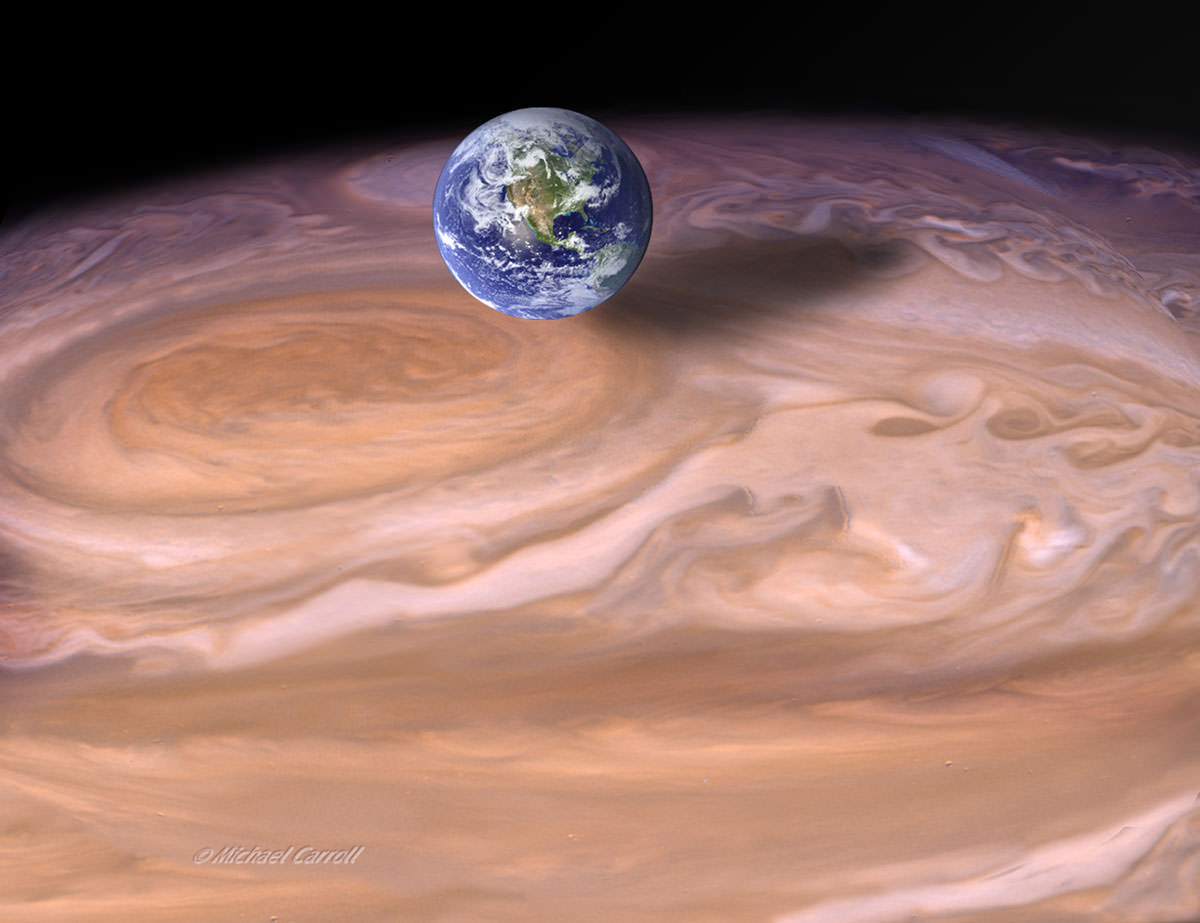
"This is the view from a spacecraft in orbit around Jupiter, looking down at the huge anticyclonic storm known as the Great Red Spot.  This storm has been a permanent feature of Jupiter for over 300 years, when it was first discovered, and it is clearly visible through a telescope from Earth. The size of the storm as shown in this picture is large enough to swallow the Earth two times whole and then some, which gives an idea of how enormously huge Jupiter is.  The texture of the planet comes from a mosaic of photos from NASAs Voyager 1 flyby in 1979, assembled and processed by Björn Jonsson..."

As Wernquist points out on his website, we now know that the Great Red Spot has slowly been shrinking, becoming more circular.  We don't know how long the Great Red Spot will persist, or even how long it has been a feature in the atmosphere of Jupiter, but we can say that it's at least older than about 350 years (since it was first observed in 1665 by Cassini).  It would be pretty awesome to be on a spacecraft in orbit of Jupiter (with great radiation shielding, of course!) and to have a chance to view a Jovian storm that's big enough to swallow our entire planet:


http://www.universetoday.com/wp-content/uploads/2011/05/RedSpotEarth.jpg


Enceladus Limb


"Shown here is a spacecraft floating through the amazing cryo geysers on the south pole of Saturn´s moon Enceladus."

The material spewing out of Enceladus' Tiger Stripes may be one of the best targets in our solar system for looking for extraterrestrial life.  That's because the water in these "geysers" may be derived from a subsurface ocean, which itself may harbor life.  The NASA Astrobiology Institute recently announced the funding of a research team led by my advisor, Alexis Templeton, here at the University of Colorado Boulder.  The work this team will be doing relates to the geochemistry of water-rock reactions and the living processes they sustain, specifically methanogenesis.  If a subsurface ocean exist on Enceladus, or on any other icy world in our solar system (like Europa!), then water-rock reactions at the interfaces of those oceans with the rocky mantles below may be the primary sources of substrates for alien biological metabolisms.  We'll likely have sent robotic orbiters and landers to worlds like Enceladus long before humans make those long voyages, but it's intriguing to think about the exploration of our solar system that those early explorers will be able to conduct.


Ringsurf


"This shot shows a person floating just above the plane of the famous Rings of Saturn. The Rings themselves are seen here only as a mess of tumbling blocks of ice, as the camera is in the middle of them, but their full shape is hinted in the shadow they cast on the northern hemisphere of Saturn, far in the distance."

On my right arm and shoulder I have a large tribal tattoo filled with various symbols from ancient cultures as well as some symbols that I felt fit my personality.  One of these symbols is derived from a drawing made by Galileo Galilei after his first observations of Saturn in 1610:


Galileo's first views of Saturn were made with such a low-resolution telescope that he could not see the structure of the rings.  Instead, he saw an orb with what appeared to be smaller orbs attached to the sides.  Over the course of years, as he made better telescopes and spent more time observing Saturn, he eventually managed to determine that what he was seeing were the rings of Saturn.  


Mars Elevator


"This shot follows the cabin of a space elevator descending on a cable towards the northern parts of the Terra Cimmeria highlands on Mars. A large settlement, hinted as glowing lights in the dark, can be seen far below on the ground. One of Mars' two moons - Phobos - is seen above the cabin to the left of the cable in the beginning of the shot."

"A small side note: As far as I have understood it, the ideal place to attach a space elevator on Mars would not be where I have done it in this shot, but on the top of the volcano Pavonis Mons. With a peak reaching 14 kilometers above Mars's mean surface level, and location almost exactly at the equator it would be the perfect spot - as it would cut a few kilometers from the length of the cable. However, the area around that mountain did not look as neat, so for purely artistic reasons I chose the Terra Cimmeria highlands instead."


Building a space elevator on Earth will be difficult enough, let alone building one on Mars, however this is a very possible future.  Building and maintaining space elevators could give us a lot of advantage over using traditional chemical propulsion to launch our spacecraft.  Savings on fuel and cutting down on pollution would be major rewards.  Although the funding for a space elevator is currently out of the scope of where our governments choose to spend our resources, it is feasible that the first space elevators could be built in the coming century, if not the coming decades.


Cape Verde


"A group of people await the arrival of a few dirigibles at the edge of the Victoria Crater on Mars."

How cool is this?!  What an inspirational scene.  There are many of us who would love to step foot on Mars and explore the Red Planet in person, but to also have the chance to sail the skies of Mars in dirigibles would be awesome.  I've long wondered if climbing Martian volcanoes and valleys would become an adventure sport of the future, but maybe bungee jumping out of dirigibles on Mars is something we might have to look forward to as well.


Blue Sunset


"This shot shows a group of hikers on top of the eastern rim of "Gusey [sic] Crater", looking at the fantastic and truly unearthly spectacle of a sunset on Mars."

This scene, of people watching the sunset from Gusev Crater, reminds me of the twin-sunset scene from Star Wars: Episode IV.  That scene, as well as this one, are provoking since we've mostly all seen the sunset on our own planet before, so we can imagine what watching a sunset on a distant world may be like.  The differences in the atmospheres of worlds should cause different effects for the sun setting, such as what this still from Wernquist shows, yet the setting of the sun (or suns) is always something worth observing while letting our minds wander contemplatively.


Iapetus Ridge


"This scene simulates a shot taken in low orbit over Saturn's moon Iapetus, looking down at a string of domed settlements built along the mighty equatorial ridge that runs along a large part of the moon's circumference."

I imagine a settlement with such a view might be the "posh" and "pricey" homes of some future people.  Looking out of a large window and seeing Saturn set amongst a pitch back background with the speckles of stars would be pretty terrific.  I could imagine myself retiring to such a place, spending my "afternoons" listening to audiobooks while watching Saturn in all of its majesty.


Excavation


"These shots show one of the many asteroids in the Main Asteroid Belt between the orbits of Mars and Jupiter. A small fleet of spacecrafts are lined up and approaching a docking area seen as glowing lights in the "center" of the large rock. The dust surrounding the asteroid is the remains of an extensive excavation of its interior."

Science fiction authors and scientists alike have long thought of the benefits of using asteroids as structural devices for building spacecraft and settlements.  An asteroid could provide a stable structure to build on, could be mined for resources, and could provide protection from the radiation within the space environment.  


Terrarium


"This shot shows the inside of the asteroid from the previous scene. Just as I wrote about that scene, this is a highly speculative vision of an impressive piece of human engineering - a concept that science fiction author Kim Stanley Robinson calls a "terraruim" in his novel "2312". It is also not unlike what Arthur C. Clarke described in his novel "Rendezvous with Rama"."

Admittedly, I have never read 2312 or Rendezvous with Rama, but this scene makes me want to read both.  I love the idea of building a colony within an asteroid.  If one could be built on such a scale as the one in this scene, then that colony and the asteroid that houses it could also be turned into a large spacecraft which could then travel out to the stars.  I can imagine a future where many exoduses of groups of humans within such asteroidal ships has caused our species to head out for the stars.  A large enough asteroid with the appropriate resources might sustain a large colony of people throughout thousands of generations.  Could such an asteroidal ship take humans out to planets and star systems many lightyears away?  What's interesting about such a thought is that there really could be asteroids or planets floating across interstellar space in our galaxy right now which are themselves home to some intelligent species that left their homeworld long ago, and maybe some such worlds are on paths that will bring them into our solar system's "backyard" sometime soon.  


Europa View


"This scene shows a group of people hiking across the icy plains of Jupiter's moon Europa. Jupiter itself as well as another moon - Io - is seen beyond the horizon."

I love Europa.  Not only does my research have direct relationship to the search for life on (and within) Europa, but that little icy world is so stunningly beautiful and so intriguing that I don't think we can help but want to explore it further.  I don't recall when I first saw pictures from the Voyager 2 spacecraft of the cracked icy surface Europa, but I do recall loving the use of Europa in 2010: The Year We Make Contact to develop the story (even if turning Jupiter into another star in our solar system would likely cause the destruction of our world, which I had no idea about when I was a kid):


Well, maybe the final message regarding Europa was a little sad:


I think many of completely intend to attempt some landings there!  We're even now considering the scientific objectives (and necessary instrumentation to achieve those objectives) that may be sought for from a Europa lander mission.  Though, before we send a lander, we will be doing our due diligence to everyone by sending an orbiter.  An orbiter mission that targets Europa could tell us so much more about the surface of that world (we only have about 10% high resolution coverage of Europa's surface thanks to the Galileo Spacecraft), including which locations are optimal for landing a spacecraft as well as for learning about the potential contact between Europa's subsurface ocean with the icy surface above.  Such an orbiter mission may come to us in the form of the Europa Clipper, a current spacecraft mission under development which may end up sending an orbiter to the Jovian system.  This spacecraft will be in an orbit of Jupiter that will also allow for tens of flybys of the Europa, giving us great coverage and instrumental analyses of the Europan surface (including some instruments that will allow us to probe the subsurface structure of that moon as well).  We may very soon see the Europa Clipper or a similar mission with Europa as a target on the launchpad.  A Europa lander should not be too long to follow afterward.  It may even be possible that a human mission to Europa will occur before I've grown completely grey in my beard.  The recent film Europa Report did a fantastic job of delivering a fairly realistic sci-fi horror about a human mission to Europa:


Although I really hope that the first human mission to Europa doesn't end so poorly for the people who travel there, I also would love if we discovered some large aquatic organisms living in the ice or in the ocean of Europa.  However, if live did ever originate and evolve on Europa, most of us who are considering what that life may be like and how it may thrive are pretty sure that such life would be something like the microbial life that dominates our world.  Although it is most likely that life never came to be on Europa (or anywhere else in our solar system besides Earth) and Europa may be a "dead world", it's still one of the more intriguing targets for astrobiological investigation of our solar system (ask me sometime what I think the number one target is.  Hint: it's not Europa, Mars, or Titan, in my opinion).


Ligeia Mare


"In orbit around Saturn is the giant moon Titan. It is the second largest moon in the Solar System (after Jupiter's Ganymede), even larger than the planet Mercury, and is the only known moon with a dense atmosphere."

Flapping my wings as I soar hundreds of meters above hydrocarbon lakes on a hazy world orbiting Staurn?  Sign me up right now!   A few years ago I posted about David Grinspoon's band The House Band of the Universe.  My favorite tune they play is called Titan Haze.  It's a pretty awesome jam, which they play with a planetarium show that takes the audience on a visual tour of Titan as the band leads them in an auditory tour of their own wonderment at the what lies below the thick haze of Titan's atmosphere:


Verona Rupes


"On Uranus´ small moon Miranda lies a monumental cliff wall believed to be the tallest in the Solar System. It is called Verona Rupes. Observations are limited but it is certain that the cliffs rise at least 5 kilometers above the ground below. Maybe even twice as much. This extreme height combined with Miranda´s low gravity (0,018g) would make for a spectacular base-jump. After taking the leap from the top edge you could fall for at least 12 minutes and, with the help of a small rocket to brake your fall toward the bottom, end up landing safely on your feet. Miranda´s close orbit around giant Uranus also makes a magnificent huge cyan ball in the sky."


We really need to send Flagship missions to Uranus and Neptune.  There's so much that we don't know about both planets and the many moons that orbit them.  Features like Verona Rupes on Miranda are all the more reason to send new missions to these worlds.  I've been tandem skydiving three times and will likely soon get solo certified, with the possibility of getting into base jumping somewhere along the way.  It would be pretty awesome to become one of the first base jumpers to do so on other worlds in our solar system.  I think jumping off of a cliff life Verona Rupes, where the gravity is so light that terminal velocity would be minimal and where you could get over ten minutes of free fall would be freaking awesome! 


Ringshine


"This is one of the most awesome views I can imagine experiencing in the Solar System; floating in a light breeze above Saturn's cloud tops at night, looking up at the glorious swaths of the Rings in the sky, and witness how they wash the cloudscape with the light they reflect from the Sun. The ringshine."

This is where Wernquist decided to end the film, with a view in our solar system that he would look forward to.  It's hopeful to imagine a day when we've developed the technology to allow ourselves to live in simple environments established around or on other worlds where all we need is a warm jacket and a face plate to keep us alive.  Better yet, there are many of us who like to envision futures where we have terraformed worlds, maybe in our solar system or elsewhere, and have made such worlds a little more livable for the fragile lifeforms we really are.  


I don't know if I can point out a singular view from somewhere in our solar system that would be my favorite or at least more yearned for, but I definitely think one view in our solar system that I would love to see with my own eyes and have a moment for contemplation would be viewing our solar system from the edge, looking back toward our star from where we could no longer see our planets, and the Sun itself would only appear as the brightest star amongst an ocean of black speckled with lights, like phosphorescent organisms flashing on the surface of wave at night.  Such a view would probably make me long to be back home on the Earth and yet would put the world that I know so well into a greater context.  Our species is a curious one.  We long for understanding of our place in the cosmos.  Yet there are members of our species who struggle just to stay alive, who can barely consider the world outside their door as their stomachs ache in the pangs of hunger or who have no access to the education to show them that their world is so much bigger than what they have been shown.  As we continue to progress forward, dipping ourselves a little further into the cosmic ocean, little bits at a time, it's a worthy and necessary exercise to seek ways to improve the lives of all of the members of our group.  As Wanderers is set to the words of Carl Sagan, I thought I'd finish this post with one of my favorite videos from internetland.  Someone took Carl Sagan's words from Pale Blue Dot and mixed them with Pink Floyd's On the Turning Away as well as with various images and video clips that fit the lyrics and the words.  Enjoy:


Sunday, November 23, 2014

Pak-Space-Man

“Science arouses a soaring sense of wonder. But so does pseudoscience. Sparse and poor popularizations of science abandon ecological niches that pseudoscience promptly fills. If it were widely understood that claims to knowledge require adequate evidence before they can be accepted, there would be no room for pseudoscience. But a kind of Gresham’s Law prevails in popular culture by which bad science drives out good.” 
- Carl Sagan, The Demon-Haunted World: Science as a Candle in the Dark


The History Channel's popular pseudoscience and pseudohistory show Ancient Aliens presents the astronomies and astrologies of ancient peoples as though such peoples were in communication and potential contact with extraterrestrial beings.  One of these proffered connections comes from a singular piece of artwork from the tomb of the Mayan ruler Pakal, which ancient aliens proponents claim to be a depiction of Pakal sitting in a rocket which is blasting off into the heavens.  It seems fairly unreasonable to think that the ancient Mayans would know what a rocket would look like, or, even worse, to assume that extraterrestrial beings that could travel through interstellar space to visit us would still have need to use chemical propulsion for rockets to leave the Earth, but it's a fascinating idea and something worth considering for those of us who are interested in the philosophy of science.  


Early Man and the Cosmos

Some years ago I took an undergraduate course at the University of Colorado that dealt with the topic of archeoastronomy (Course Website).  We discussed some of the various ways that people in ancient and modern times have considered their place in the cosmos through their observations of the night's sky: including the megalith constructors of ancient England, Polynesian navigators, the alignment of the Egyptian pyramids, and the mythologies of the aboriginal people from Australia.  I have always found these considerations to be quite fascinating.  From the mythologies built around constellations and the movements of the stars and planets to architectural alignments with the heavens, I think one of our greatest connections with our ancestors from across the planet is our awe and wonder when we ponder the cosmos through the night's sky.  I recently decided to go back and fully read the text that was required for this undergraduate course.  That book, Early Man and the Cosmos by Evan Hadingham, was a bit dry and somewhat dated (published in 1984, when I was only finishing my first orbit around the Sun) but I found it to be an enjoyable and fascinating read.  The book focuses primarily on the megalith constructors of ancient Great Britain, the people of the American southwest (Chumash, Zuni, Hopi), and the ancient Mayans, though the author does a good job of placing these people and their understandings of the heavens within the greater context of our modern knowledge and the development of astronomies and astrologies in various forms through history.  Hadingham presented the brief history of lord Pakal, a Mayan ruler from the 7th century C.E., and his decorated sarcophagus lid in a section of the book subtitled "Lords of Palenque".  Although Hadingham reviewed what real archeologists and historians make of the artwork on the sarcophagus and it's context within Mayan culture, the author made mention of the claim in Erich von Däniken's 1968 book Chariots of the Gods? that the sarcophagus depicts the great Mayan ruler blasting off in a rocket.


Pakal - Mayan Ruler or
The Palenque Astronaut?

K'inich Janaab' Pakal (also known as Pacal) was a ruler of the Mayan land of Palenque beginning some 1400 years ago.  During Pakal's reign over Palenque, he had the Palace of Bàak' expanded and he came to be revered by his people.  After his death, Pakal was deified and many of his descendants would claim their right to rule through their connection with him.  Pakal was entombed in the Temple of Inscriptions, but his tomb was not discovered by modern scholars until 1948.  The iconography in Pakal's tomb depicts the various connections between the great ruler and the mythological considerations of the cosmos by his people, but the iconography in the tomb that has been of the greatest interest to scholars comes from the lid of Pakal's sarcophagus:


(Image created by Wikipedia user Madman2001)

The sarcophagus lid appears to show Pakal at center as he makes his journey into the world of the dead.  Growing around him is a world tree, a common depiction in ancient Mayan art, with its roots growing down into the underworld and it's branches extending toward the heavens.  Around the edges of the lid are depictions of the Sun, Moon, and stars as well as those of ancient nobles, perhaps real Mayan rulers or mythological figures. 

The proponents for the existence of ancient aliens see the depiction on Pakal's sarcophagus as being something different.  They suggest that the lid shows Pakal sitting within a spaceship, with exhaust coming out of the back of the capsule, Pakal's hand on controls, and his foot on some kind of a pedal for controlling the ship.  It sounds like a connection that could only be made once the space age began and that it exactly the case: Erich von Däniken suggested that the image depicts Pakal as a spaceman sitting in a pose similar to that of the Mercury astronauts from the early American space program.  


The Ancient Aliens show and the claims from proponents of those ideas are pretty easy to debunk.  Indeed, Chris White has a great 3-hour film where he breaks down most of the ideas of ancient aliens.  The film and relevant information for each major claim from ancient aliens can be found at White's website Ancient Aliens Debunked.  White has a fantastic breakdown of the claims about Pakal's sarcophagus. Since posting this back in 2014, the video link I used to have to White's videos no longer works (but definitely check out the website). However, here is a pretty awesome video from Hoax Factor considering Pakal's tomb:  


White definitely shows that the ancient aliens hypothesis in the case of lord Pakal has very little ground to stand-on.  None of their claims fit within the broader context of the known mythologies, history, or artwork of the ancient Mesoamerican peoples.  Indeed, this one image can be viewed as though it's a picture of Pakal in a spaceship, but that viewpoint doesn't appear to have any historical legitimacy.  Why then do proponents of ancient aliens continue to proffer this bogus idea?


Seeing Faces and Hot Rods of the Gods

As many of us know, it's a natural human tendency to see what we want to see when we look at our world.  We have a proclivity for seeing things like faces in burnt toast, in clouds, and in inanimate objects in our lives.  When we have mental filters in place for what the world around us should look like, we are then more likely to view the world in that way.  It's not too hard to see then how a fairly uneducated person like Erich von Däniken could look at Pakal's sarcophagus and see an image that reminded him of the reclined Mercury astronauts blasting off in their space capsules.  The Mercury program had been widely known at the time that 
von Däniken wrote his first book on the subject.  Erich von Däniken has long stood by his claims (he even built a theme park to present his ideas as though they are fact), but it's seems like the real problem is that von Däniken can't see past his own personal experience having spent most of his life in the 20th century.

It's a good exercise in critical thinking to try to step away from the world we know and to attempt to view the cosmos through the lens of another culture at another time in history.  That's part of why I enjoy learning about ancient peoples and their considerations of the heavens.  As a scientist, I work within the current paradigm of scientific thought and application, but to truly appreciate what modern science is and how it works, it's good to think about all human endeavors to understand our universe.  The final words from Evan Hadingham in Early Man and the Cosmos iterates this point beautifully:


"When we consider ancient astronomy, we begin to value the complexity and logic of other schemes of thought besides our own.  We realize that our framework of ideas developed from only one system of thought out of many that have passed into obscurity.  The perspective of other peoples, sometimes glimpsed across a gap of countless generations, reminds us of the shortcomings of our own outlook, and there are indeed many others.  Such an awareness may be essential for our own survival"


Worthwhile Gobbledygook?

“Deluded or not, supporters of superstition and pseudoscience are human beings with real feelings, who, like the skeptics, are trying to figure out how the world works and what our role in it might be. Their motives are in many cases consonant with science. If their culture has not given them all the tools they need to pursue this great quest, let us temper our criticism with kindness. None of us comes fully equipped.” 
- Carl Sagan, The Demon-Haunted World: Science as a Candle in the Dark

Many of us can sometimes be too quick to judge proponents of the ancient aliens ideas.  Much like people who believe in ghosts, fairies, gods, faith healing, homeopathy, or the power of prayer, the proponents of the ancient aliens hypotheses have viewpoints about our world that they feel are justified and they are trying to make sense of the world for themselves within those viewpoints.  The separation of science from pseudoscience comes in the rigor and method of acceptance and denial in science and the lack thereof in pseudoscience, yet it has been a complicated and non-trivial affair for philosophers of science and scientists to truly determine how the demarcate science and how to fully describe science.  Science itself covers a range of approaches and considerations.  Who's to say that the science we practice now will be anything like the science practiced by people to come centuries or millennia from now?  In some ways, we scientists are also guilty of building up mental filters that control how we allow ourselves to see the universe.  Although ancient aliens ideas have no legitimacy in the sense of the history they present, they are still important concepts in our modern history as they represent the growing want of many people to know what extraterrestrial life may be like and whether or not we are alone in the universe.  If anything, I wonder if some of these ancient aliens ideas may be a way for some people to try to build a connection with the greater cosmos.  Those of us who consider ourselves communicators and educators of science should approach such ideas as ancient aliens in that respect and show the public that we can know about our connection with the universe through science.  Even though we haven't yet discovered any evidence for alien life to exist and there's most assuredly no evidence that aliens have ever visited the Earth, that doesn't mean it's not fun to think about the possibilities for other life in our universe.


Here's all 3 hours of Ancient Aliens Debunked:

Sunday, November 16, 2014

Plutarch Dies at the End

Wallowing in my own self-pitty last night due to the continued presence of my runny nose, cough, and stuffed-up sinuses from this damned sickness I've had, I sought out a horror film to watch alone and in the dark.  I came upon John Dies in the End while searching through my Netflix queue.  I had added said film because it sounded promising, though I couldn't recall having ever seen a trailer or read any reviews.  So I jumped to the ol' Google and found the film's trailer to be enticing.  The film is definitely worth a watch for anyone who enjoys humorous comedy, but I'm not offering a review of the film here.  Rather, I'm writing this because of one interesting part of the film: the prologue.  

The opening of the film presents a simple thought experiment in a not-so-simple and enjoyably quirky way:


What do you think?  If you're anything like me, the first answer that comes to your mind is an obvious "no".  The axe has been completely re-constructed, so the original parts that were used to behead the now-rotting, corpsified zombie-dude are no longer in your possession and are most likely just adding to the mass of waste at some local landfill.  

However, that's not the reason that I think the answer of "no" is astoundingly obvious (you might not have caught the primary reason for the answer being "no" on your first watch of that video; if so, watch it again.  Good to go?  Awesome).  Hopefully you saw that the primary reason that the answer to the question is "no" is because what slew Swastika-Tongue in the first place was one, some, or all of the eight bullets that you had shot him with before using the axe to remove his head (like I said, it's a simple riddle).  However, if you take away the obvious answer and just allow yourself to assume that the real question of the riddle is whether or not the axe you now hold in your hand in the presence of Zombie-Swastika-Tongue is the same one that you had used the previous winter to remove the head of his former self, then you have another riddle that is really a re-hash of a much older thought experiment: The Ship of Theseus.

The Ship of Theseus is a thought experiment proposed by Plutarch in the first century C.E.  It goes something like this: the ship in which the hero Theseus and the young Athenian men returned from Crete (see the myth of Theseus and the Minotaur) was honored by Athenians and kept in good repair in the harbor of Athens for many centuries.  Over time, as parts of the ship would degrade, they were slowly replaced, so eventually there were not many of the original parts of the ship remaining.  The question then became "Is the ship, after replacing part for part over time, still the Ship of Theseus?"

The thought experiment, as it stands, really questions the value an object has based upon its parts.  It's a question of philosophical identity.  

There are other versions of this thought experiment.  Some of them predate Plutarch's Ship of Theseus.  For instance, there is a version in which Socrates and Plato each slowly exchanged the parts of their carriages such that the parts that once were in Plato's carriage have been completely replaced with parts from Socrates' carriage and vice versa and then the question is posited as to whether Plato is now using Socrates' carriage or if he's still in his own.  

Other variants of the thought experiment have come since the time of Plutarch (with some interesting additions).  The version that appears most similar to the prologue from John Dies at the End is the one known as "My Grandfather's Axe": my grandfather had an axe which he gave to my father.  My father replaced the haft before giving the axe to me.  I had to replace the head.  Do I still have my grandfather's axe?

One of the more interesting variants of this thought experiment was proposed by Thomas Hobbes, the 1700's English philosopher and author of Leviathan.  Hobbes' addition to the thought experiment works this way: you have the Ship of Theseus.  You slowly take one piece of the ship off and replace it with a new piece.  The old piece you keep.  You continue in this manner, replacing pieces of the ship and saving the removed pieces.  As this is happening over time, you take the pieces that had been removed and use those pieces to build a new ship, of exactly the same structure and design.  By the time you have replaced the final original piece of the ship, you now have two identical ships.  Which one is the Ship of Theseus?

Here's a fantastic breakdown of the original Ship of Theseus thought experiment and the Hobbes version from Wireless Philosophy:


The thesis of Joseph Butler, as reviewed in that video and suggesting that "objects persist in only a loose and popular sense", seems like a nice way to shrug off the problem as not being a problem in the first place.  This is usually a fun approach to a lot of philosophy problems since a lot of the time it seems like there's no resolution to a lot of philosophy problems.  

The reason I like this thought experiment, be it after replacing axe parts following your unexplained need to slay and behead some dude with a swastika tattooed on his tongue or replacing pieces of Theseus' ship, is because it questions identity.  We are constantly shedding cells and gaining new ones, so are we ever identical with who we were previously?  Darth Vader was almost fully replaced by mechanical parts, so was he still Anakin Skywalker?  The philosopher Wittgenstein might have thought these questions were balderdash ("Roughly speaking: to say of two things that they are identical is nonsense, and to say of one thing that it is identical with itself is to say nothing") and, if that were the case, he might have been right.

It would be interesting if we could just say that something is such because people agree to call it such.  Maybe the Ship of Theseus is really just whatever anyone decides to call "the Ship of Theseus".  Maybe Darth Vader is Anakin Skywalker because someone calls him so.  If that were the case, then the answer to the thought experiment as proposed in John Dies at the End might be that the axe you're holding in your hand is the same axe as the one that beheaded Swastika-Tongue because his zombie has now said that it is the same axe (it might be a good conclusion since chances are you should be more worried about dealing with said zombie before considering philosophical puzzles anyway).  

However, I still feel like the answer would be "no".  Even if you had killed the dude with an axe in the first place (and not with one, some, or all of those eight bullets), the original axe has been completely replaced.  The answer feels like "no" because none of the original axe remains and there are only two major parts of the axe to replace.  When the problem is introduced as in the case of the Ship of Theseus, where the object is replaced a small amount at a time, that's when it gets harder to decide when to even consider the ship to no longer be the original.

Maybe one of the more interesting answers comes from those who like to add the temporal dimension to the consideration, such as in the Worm Theory as presented in the video above.  When we question the temporal aspect of an object along with it's identity, we start hinting at a possible answer to the question (see Temporal Parts at Stanford Encyclopedia of Philosophy).  We can say that any one thing is only ever fully identical to itself at one point in time, but then at other points in time it can only be similar to itself.  Then using a name to define something falls back to the "loose and popular" context that Butler suggested.  That sounds just about right, honestly.  The answer that would suggest then is that the Ship of Theseus was only the same ship in the sense that it bore similarity to itself over time and that people still called it the Ship of Theseus is the only thing that made it the Ship of Theseus.  In that case, the axe that hewed the head laden with a swastika-marked tongue and the axe that you now have to defend yourself against the zombie at the door are only similar, and maybe you would call it a different axe since you know you've replaced the parts but the zombie calls it the same axe since it looks similar to the original.  Not a very rewarding answer, but an answer nonetheless (and now you can get on with hacking down the zombie as he is more than likely about to come at you).

There's rich food for thought there.  Maybe Wittgenstein is right and it's nonsense to even worry about two things being identical.  That seems to fit well with the answer that considers the temporal aspect to mean that an object has unique temporal parts during its existence (look up perdurantism).  Whatever anyone's consideration of this little thought experiment may be, I think we can all agree that it's a lucky thing we don't truly live in a world where a guy can get shot 8 times and have his head chopped off with an axe but then still find a way to come back from death and then sew his head back on before coming to find us with the likely intent of exacting revenge.

Update (22 October 2017): I re-shared this recently and have had several people ask if I've read the book John Dies at the End. Happily, I can say, yes, I have, and I've also read the sequel, This Book is Full of Spiders. A third book in the series, What the Hell Did I Just Read: A Novel of Cosmic Horror, just came out this month. Looking forward to reading that as well!